Introduction
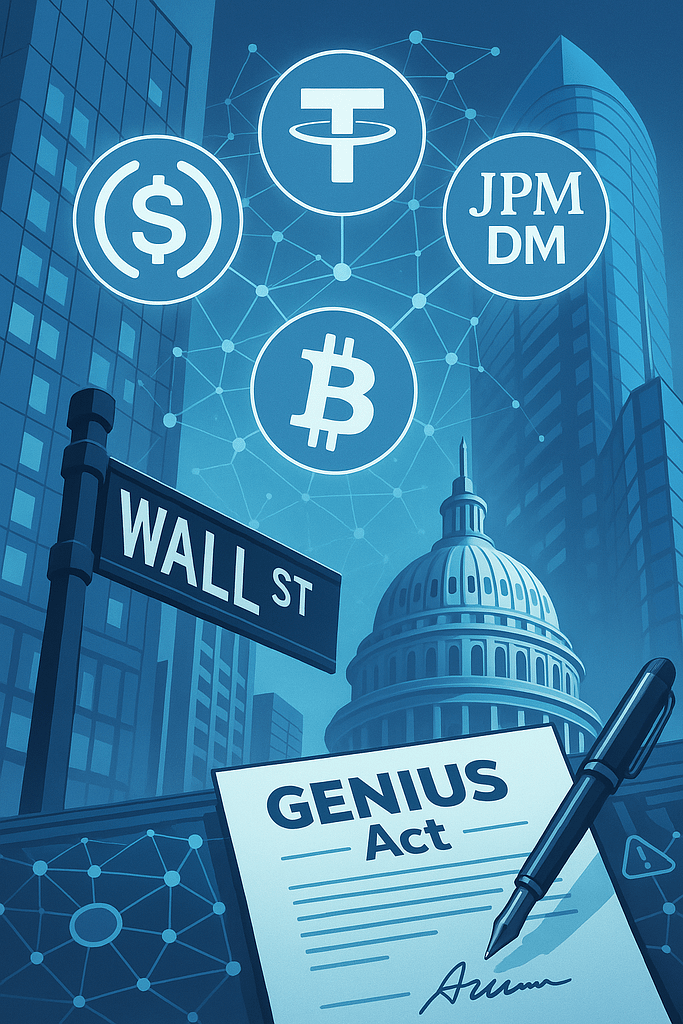
The stablecoin market, valued at over $250 billion in 2025, has caught the attention of Wall Street titans like JPMorgan, Charles Schwab, and Citigroup. The GENIUS Act, signed into law on July 18, 2025, provides a federal framework for stablecoins, spurring adoption by traditional finance. Jesse McWaters of Mastercard told Decrypt, “This signals a new era of confidence.” This article examines Wall Street’s stablecoin push, the impact of new regulations, the competition between stablecoins and tokenized deposits, and strategies for investors navigating this booming sector.
Wall Street’s Stablecoin Ambitions
Major banks are diving into stablecoins, driven by their potential for instant settlements and programmable finance. JPMorgan’s JPMD token, piloted on the Base blockchain, aims to streamline cross-border payments, with CEO Jamie Dimon citing its “efficiency in global trade.” Charles Schwab’s Rick Wurster told CNBC, “Stablecoins are key for blockchain transactions,” as the firm explores issuing its own token. Citigroup and Bank of America are also developing stablecoin solutions, with Standard Chartered forecasting a $750 billion market by 2030.
Tether (USDT) dominates with $179.3 billion in circulation, while Circle’s USDC handles $28.2 billion in daily transactions. The entry of banks could challenge these crypto-native issuers, leveraging their regulatory compliance and client networks. OKX’s adoption of USDG, a new stablecoin, highlights growing competition in the space.
The GENIUS Act: Regulatory Clarity for Stablecoins
The GENIUS Act mandates that stablecoin issuers hold reserves in high-quality assets, such as U.S. Treasuries, and comply with audits. This framework, passed with a 307-122 House vote, reduces risks of mismanagement, as seen in past stablecoin controversies. Treasury Secretary Scott Bessent emphasized its role in “strengthening U.S. dollar dominance.” The act benefits issuers like Circle, which has aligned USDC with regulatory standards, and encourages banks to enter the market.
The legislation also integrates stablecoins into traditional finance. Bank of America’s research suggests stablecoins could facilitate trillions in daily blockchain transactions, from trade finance to retail payments. However, compliance costs may disadvantage smaller issuers, consolidating the market around established players.
Tokenized Deposits vs. Stablecoins
JPMorgan’s research, reported by The Block, highlights a global preference for tokenized deposits—bank-issued digital assets tied to fiat reserves—over stablecoins. Unlike stablecoins, tokenized deposits are non-transferable outside banking systems, reducing volatility risks. Countries like Singapore and the EU favor this model, with the EU’s MiCA framework prioritizing stability. The U.S.’s pro-stablecoin stance via the GENIUS Act diverges, potentially creating a fragmented global market.
Despite this, stablecoins offer unique advantages in DeFi, enabling seamless transactions across decentralized platforms. Ethereum’s role as the backbone for USDC and other tokens strengthens its ecosystem. Investors must weigh the trade-offs between stablecoins’ flexibility and tokenized deposits’ regulatory favor.
Opportunities and Risks
Stablecoins offer low-risk exposure to crypto, ideal for conservative investors. Their integration into payment systems, like Mastercard’s blockchain initiatives, could drive mainstream adoption. However, regulatory divergence poses challenges. Hungary’s strict laws and Asia’s rising scam activity, per Chainalysis, highlight global risks. DeFi platforms face increased scrutiny under the CLARITY Act, potentially limiting stablecoin use cases.
Investors should use regulated platforms like Coinbase, which comply with the GENIUS Act, and monitor macro trends like U.S. inflation data. Stablecoin staking in DeFi can yield 5-10% annually, but due diligence is critical to avoid scams, as seen in the $2.17 billion lost in 2025.
The Future of Stablecoins
With Wall Street’s backing and regulatory clarity, stablecoins are poised to redefine finance. The GENIUS Act’s framework could drive adoption, while the CLARITY Act’s Senate vote will shape DeFi’s role. Cryptofeedhub’s newsletter offers insights into stablecoin trends, investment strategies, and regulatory updates to keep you informed.

Stay Ahead of the Crypto Curve
For real-time updates and in-depth analysis, follow us on X (@CryptoFeedHub) and explore our full news archive at CryptoFeedHub.com.
Why follow us?
- 🔄 Breaking news alerts – Be first to know about market-moving events
- 📊 Expert analysis – Institutional-grade insights on trends and regulations
- 🚀 Exclusive content – Deep dives you won’t find anywhere else