Introduction
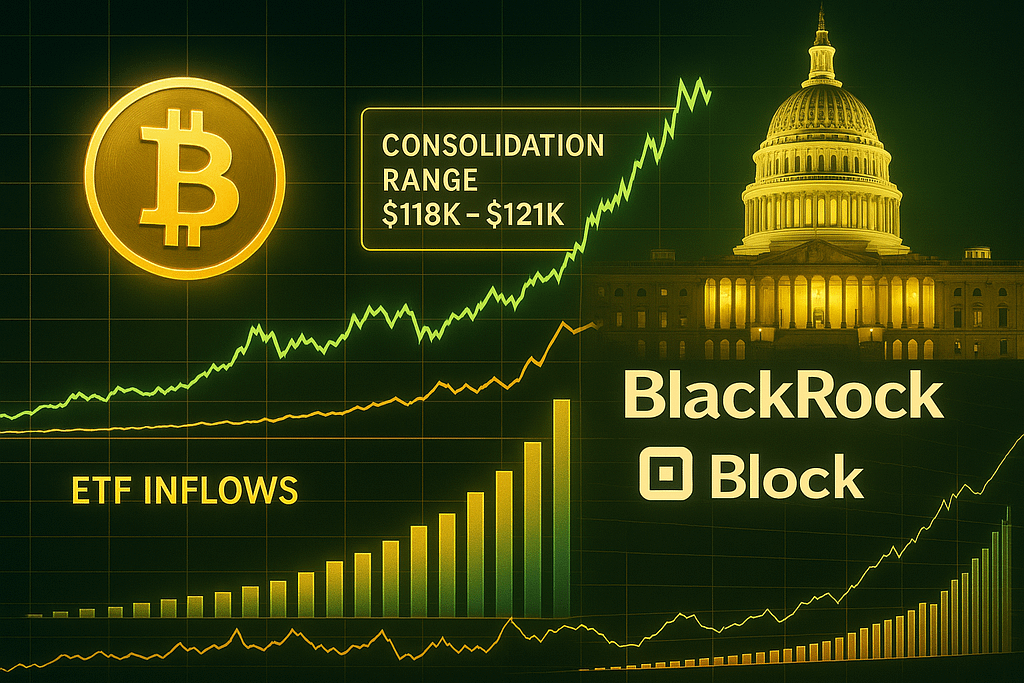
On July 14, 2025, Bitcoin (BTC) reached a record high of $123,205, propelled by institutional inflows and regulatory clarity, before entering a consolidation phase around $118,000-$121,700, according to Cointelegraph (https://cointelegraph.com/news/bitcoin-price-consolidation-phase-possible-july-highs-forecast-trader). Galaxy Digital’s Michael Harvey noted, “Consolidation around current prices is my base case given the large rally,” but analysts like Cooper Research forecast a potential surge to $150,000 by October (https://decrypt.co/330928/bitcoin-poised-rally-150k-october-cooper-research). With spot Bitcoin ETFs recording a 12-day inflow streak of $363 million and corporate treasuries like Block Inc. embracing BTC, the market is poised for significant movement (https://cointelegraph.com/news/spot-bitcoin-etfs-363m-inflow-12-day-streak). This article explores Bitcoin’s consolidation, the drivers behind its momentum, macroeconomic risks, trading strategies, and the path to new highs in 2025.
Understanding Bitcoin’s Consolidation Phase
Bitcoin’s current consolidation follows a 20% rally from $100,000 in June, stabilizing between $118,000 and $121,700, per CoinDCX data (https://cointelegraph.com/news/bitcoin-price-consolidation-phase-possible-july-highs-forecast-trader). Technical indicators support a bullish outlook: a bullish engulfing pattern, with a 78% success rate since 2021, suggests new highs are possible by July’s end, per Cointelegraph. The realized cap grew by $30 billion since April, reflecting sustained investor confidence, while the Crypto Fear & Greed Index at 78 indicates strong bullish sentiment ().
However, consolidation has risks. Social media dominance, with 43.06% of crypto discussions on X focused on Bitcoin, signals a potential short-term top, per Santiment (https://cointelegraph.com/news/bitcoin-price-consolidation-phase-possible-july-highs-forecast-trader). Key support levels at $112,065 (20-day EMA) and $107,900 (50-day EMA) are critical to watch, as a break below could trigger a correction to $105,000, per TradingView analysis. Conversely, a breakout above $122,000 could push BTC toward $125,000, aligning with Jeff Mei of BTSE’s two-month prediction ().
The Power of ETF Inflows
Spot Bitcoin ETFs have been a major catalyst, with a record $1.18 billion in inflows on July 10, 2025, and a 12-day streak of $363 million, led by BlackRock’s IBIT (https://cointelegraph.com/news/spot-bitcoin-etfs-363m-inflow-12-day-streak). This influx reflects institutional confidence, with 1.4 million BTC now held in ETFs, per BitcoinTreasuries.NET. Jeff Mei told CNBC, “Bitcoin’s surge is driven by longer-term institutional buyers,” forecasting $125,000 soon (https://cointelegraph.com/news/bitcoin-price-consolidation-phase-possible-july-highs-forecast-trader). The correlation between ETF inflows and price spikes is evident: on days with inflows above $500 million, BTC gained an average of 3.2%, per Farside Investors.
Retail investors are also joining the trend, with platforms like Coinbase reporting a 300% increase in BTC trading volume since June. The GENIUS Act, signed on July 18, 2025, has bolstered confidence by providing a stablecoin framework, indirectly supporting Bitcoin’s role as a store of value (https://cointelegraph.com/news/us-lawmaker-alarm-genius-bill-cbdc-trojan-horse). However, concerns about a “CBDC Trojan horse” in the GENIUS Act, raised by lawmakers, highlight ongoing regulatory debates that could impact investor sentiment ().
Corporate Adoption: Block and Beyond
Corporate treasuries are driving Bitcoin’s adoption. Block Inc., founded by Jack Dorsey, holds 8,584 BTC valued at $1.01 billion and joined the S&P 500 on July 23, 2025, boosting its stock by 9% after-hours (https://cointelegraph.com/news/block-inc-jack-dorsey-s-and-p-500-us-stocks-surge). Dorsey’s strategy includes monthly BTC purchases and a mining system, positioning Block as a crypto leader. Similarly, Metaplanet, a Japanese firm, aims to hold 3,000 BTC by Q4, per CryptoSlate. These moves signal a shift toward Bitcoin as a corporate reserve asset, with over 1.1 million BTC held by companies, per BitcoinTreasuries.NET.
The S&P 500 inclusion of Block and Coinbase could attract trillions in passive flows, as noted by WiseSummit on X: “This is trillions inching closer to Bitcoin” (https://cointelegraph.com/news/block-inc-jack-dorsey-s-and-p-500-us-stocks-surge). This trend enhances Bitcoin’s legitimacy, drawing parallels to gold’s role in traditional portfolios. However, corporate concentration in BTC custody (6.6% of supply) raises centralization concerns, potentially undermining its decentralized ethos, per CryptoSlate analysis.
Macro Risks and Regulatory Tailwinds
Regulatory clarity is a tailwind. The GENIUS Act and the proposed CLARITY Act, which shifts oversight to the CFTC, reduce uncertainty, encouraging institutional participation (https://cointelegraph.com/news/stellar-xlm-xrp-rally-donald-trump-crypto-sign-bill-hodlers-digest). President Trump’s Bitcoin reserve proposal further fuels optimism, with 401(k) plans potentially allocating $90 billion if 1% of $9 trillion in U.S. funds invest, per Dragonfly’s Omar Kanji.
However, macro risks loom. Tim Draper warned Cointelegraph that a strengthening U.S. dollar or Federal Reserve rate hikes could dampen Bitcoin’s rally (https://cointelegraph.com/news/macro-factors-dampen-bitcoin-halving-tim-draper). The Bank of Japan’s quiet dollar liquidity moves, noted by CryptoSlate, could signal global volatility, impacting risk assets like BTC (https://cryptoslate.com/bank-of-japans-quiet-dollar-liquidity-move-warning-sign-or-just-the-beginning/). Investors should monitor U.S. CPI data on July 24 and Fed decisions in September, which could trigger a 5-10% correction if hawkish.
Trading Strategies for the Consolidation Phase
Investors can capitalize on consolidation by buying dips near $112,065, using dollar-cost averaging to mitigate volatility. Regulated platforms like Coinbase or Kraken, compliant with the GENIUS Act, ensure safety. Monitoring X sentiment via Google Gemini, as Cointelegraph suggests, can identify buying opportunities by analyzing hashtags like #Bitcoin or #BTC (https://cointelegraph.com/news/how-to-use-google-gemini-to-turn-crypto-news-into-trade-signals). Set stop-losses at $107,900 to manage downside risk. Diversifying into altcoins like Ethereum or XRP, which are gaining momentum, balances exposure.
For long-term investors, allocating 5-10% of portfolios to Bitcoin ETFs offers institutional-grade exposure. Staking stablecoins like USDC on platforms like Aave provides 5-15% APY for conservative strategies. Cryptofeedhub’s newsletter delivers real-time market signals, ETF updates, and macro analysis to guide decisions.
The Path to New Highs
Cooper Research’s $150,000 forecast by October hinges on sustained ETF inflows, corporate adoption, and regulatory clarity (https://decrypt.co/330928/bitcoin-poised-rally-150k-october-cooper-research). A breakout above $122,000 could trigger a rally to $125,000-$130,000, supported by historical patterns and whale accumulation, per Glassnode. However, a drop below $107,900 risks a correction to $100,000. The CLARITY Act’s Senate vote, expected by year-end, and macro data will shape Bitcoin’s trajectory. Subscribe to Cryptofeedhub for weekly insights to navigate this bull market and stay ahead of the curve.

Stay Ahead of the Crypto Curve
For real-time updates and in-depth analysis, follow us on X (@CryptoFeedHub) and explore our full news archive at CryptoFeedHub.com.
Why follow us?
- 🔄 Breaking news alerts – Be first to know about market-moving events
- 📊 Expert analysis – Institutional-grade insights on trends and regulations
- 🚀 Exclusive content – Deep dives you won’t find anywhere else